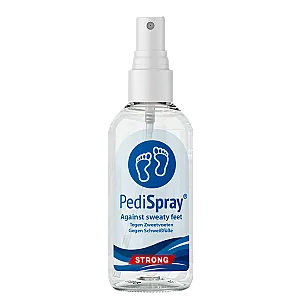


PediSpray® Regular
Direct reduction of perspiration
Damp feet, wet socks and a strong odour indicate that moisture is remaining on the skin and inside footwear for too long. Closed shoes trap heat and moisture, making it easier for bacteria and fungi to develop.

Simply washing your feet is not enough. Socks, insoles and the lining of your shoes must also be included in your daily routine.
What can be done about sweaty feet? Keep your feet, socks and shoes dry and tackle the problem on two fronts: reduce excessive sweating on the skin of the feet and treat moisture and odour inside the footwear.
Wash and dry your feet thoroughly. Wash your feet daily and dry them thoroughly between the toes.
Reduce sweating on the feet. If your feet quickly become clammy or wet, use a spray for sweaty feet, such as PediSpray®.
Put on clean, dry socks. Wear a clean pair every day and change your socks as soon as they become damp.
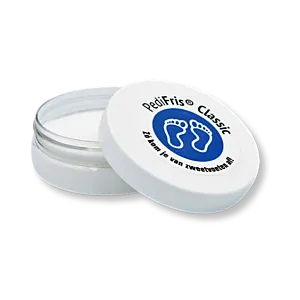
Treat your shoes. Use PediFris® Classic, a powder for sweaty feet, in shoes to tackle odour-causing bacteria and fungi.
Alternate your shoes and allow them to dry completely. Remove any loose insoles, dry them separately and do not wear the same pair every day.
Sweaty feet are feet that regularly become clammy or wet due to excessive sweating. Sweating is normal in hot weather, during exercise and when feeling stressed. The medical term for excessive sweating is hyperhidrosis.
Fresh sweat has hardly any odour. Odour mainly arises when bacteria on the skin or in damp footwear break down sweat into substances that do have an odour. As a result, wet feet and shoe odour sometimes require two different solutions.

.svg)
 Jan henk Crouwers
Thomas De Jager
Roger Schmidt
Wicher
IdKvH
Helmut Tijssen
Bernd
Pim
Jan henk Crouwers
Thomas De Jager
Roger Schmidt
Wicher
IdKvH
Helmut Tijssen
Bernd
Pim
 Bernd
Bernd
 roger christiaen
As well as targeted treatment, everyday choices regarding socks and shoes can also help.
Socks for sweaty feet: When choosing socks for sweaty feet focus mainly on whether they absorb moisture and stay sufficiently dry in your shoes during your activity. Take a spare pair with you for work, sport or hot weather.
Footwear for sweaty feet: For closed shoes, separate tips apply for sweaty feet in work shoes. If you wear open-toed footwear, choose the approach for sweaty feet in sandals, sweaty feet in flip-flops or sweaty feet in Crocs.
Brief answers on causes, self-care, treatments and when a medical assessment is advisable.
Feet may sweat excessively due to heat, exertion, stress or a predisposition. Discuss any new, nocturnal, unilateral or sudden sweating affecting the whole body with your GP.
For extremely sweaty feet, daily drying, clean socks and an antiperspirant containing aluminium salts are the usual first steps. Ask your GP for advice if the condition is affecting your daily life or is not improving sufficiently.
Choose clean socks that can absorb moisture and shoes that are well-ventilated and can dry completely. Change your socks as soon as they get wet and do not wear the same pair of shoes every day.
Make an appointment if excessive sweating significantly disrupts your daily life, changes suddenly, occurs mainly at night, is noticeably worse in one foot, or is accompanied by other symptoms.
A deodorant without aluminium salts does not reduce the amount of sweat and focuses primarily on odour. An antiperspirant containing aluminium salts helps to temporarily reduce sweat production on the treated skin.
Can’t decide between a spray and a powder? Compare which remedy for sweaty feet suits your condition best.
Aluminium chloride is an aluminium salt that can reduce perspiration on the treated skin. Apply a suitable product to dry, intact skin and discontinue or reduce use if irritation becomes apparent.
Written by Judith de Jong (Content owner, PediFris®). Medically reviewed by Sébastien Dequidt, podiatrist. Updated on 23 August 2026. We base our advice on foot care practice and on the medical sources listed below.
Worried about a persistent complaint, fungal nail, athlete’s foot or excessive sweating? Consult your GP, podiatrist or chiropodist.
Use each product according to the instructions on the packaging. Apply PediSpray® to clean, dry and intact skin on the feet, and use PediFris® Classic only in shoes. Reduce or stop using a product applied to the skin if clear irritation occurs.

.svg)